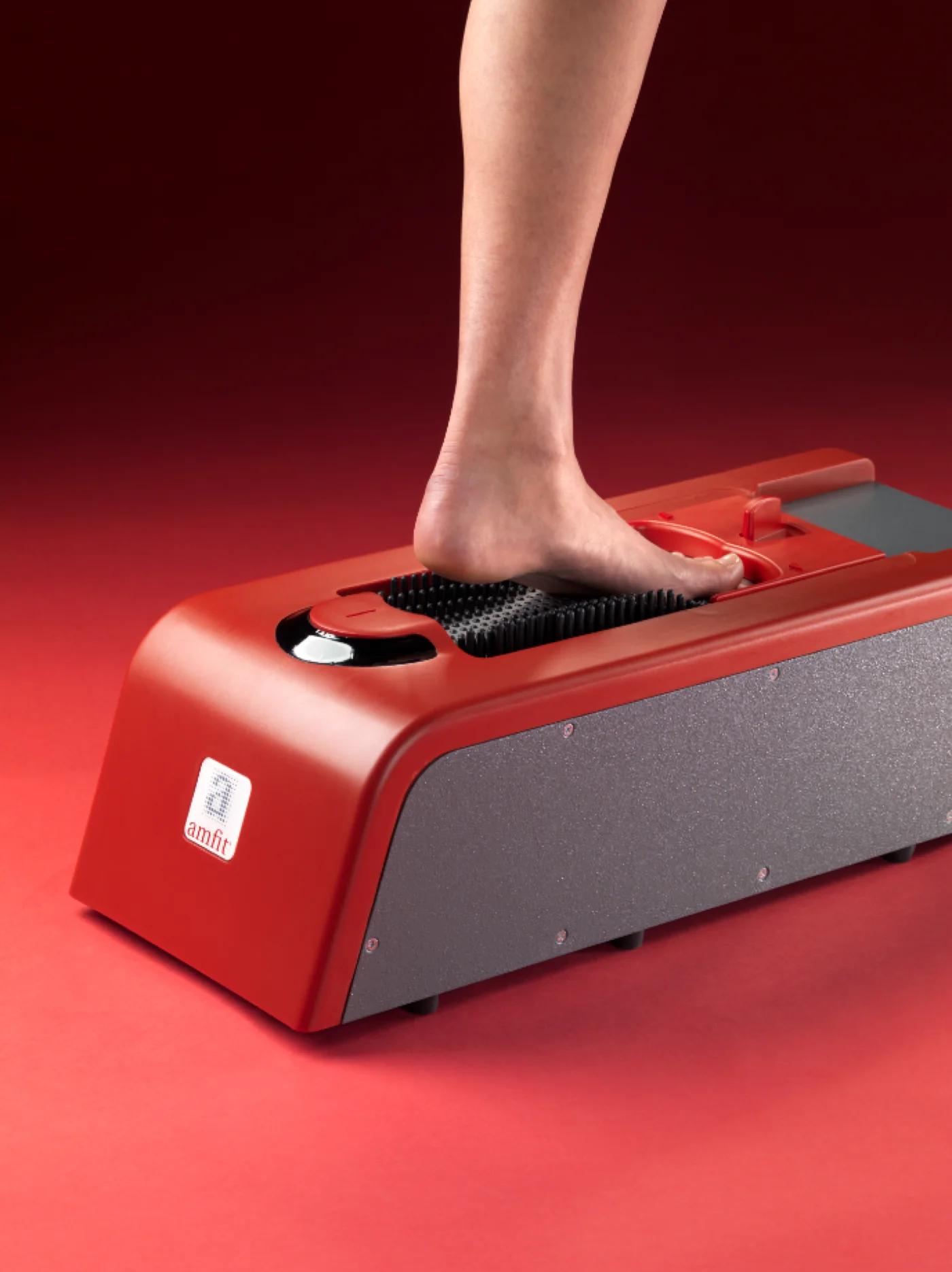
Before corrections are made or fabrication begins, the amount of weight placed through the foot helps define the contour recorded.
With the Amfit Contact Digitizer, providers can capture the foot under full, partial, or minimal load. Each condition creates a different starting contour, allowing the provider to choose what the captured shape should represent in the finished orthotic.
Research reinforces why that choice matters. A 2025 study comparing foot-scanning conditions found that weight bearing had a greater influence on orthotic insole design than the scanner selected when evaluating healthy feet.
We observed that the weight bearing of the foot plays a more important role in orthosis design than the choice of the scanner itself in the context of orthotic insole design for a healthy foot.
The takeaway is not that one method is always better. It is that loading should be selected intentionally because it helps establish the shape carried into the orthotic design.
Weight-Bearing Foot Capture
During full weight-bearing capture, the patient stands on the Contact Digitizer with their weight distributed evenly between both feet.
This method records the foot closer to the shape it takes while supporting the patient’s body weight. It may be selected when the provider wants the design to reflect the loaded contour, including changes in arch shape, soft tissue, and overall foot width.
A balanced and consistent stance is important because changes in weight distribution can affect the contour recorded.
Semi-Weight-Bearing Foot Capture
Semi-weight-bearing capture allows the provider to record some of the foot’s response to load without allowing full body weight to flatten or spread the contour.
Reducing pressure, particularly through the heel, can preserve a deeper heel shape and support a more aggressive heel cup. This provides a middle ground between the fully loaded contour of weight bearing and the greater positional control of non-weight-bearing capture.
Learn more about this design consideration in Why Heel Cup Depth Matters.
Non-Weight-Bearing Foot Capture
Non-weight-bearing capture may be selected when the provider wants to position the foot before body weight changes its shape.
This can be useful when working with a flexible deformity or when standing is painful or difficult.
The patient remains seated while the provider supports the lower leg, heel, and forefoot, holding the foot in the intended position as it rests lightly on the Digitizer’s pins.
The resulting contour reflects the position selected by the provider rather than the shape created under full standing load.
Choosing the Appropriate Capture Condition
The selected loading condition should support what the provider wants the finished orthotic to accomplish.
Considerations may include:
- How the foot changes when weight is applied
- Whether the loaded contour should be accommodated or modified
- The desired position of the heel, rearfoot, and forefoot
- The amount of control needed during capture
- How the finished orthotic will work within the patient’s footwear
The choice may also depend on whether the design is corrective or accommodative. Learn more in Accommodation vs. Correction in Orthotic Design.
Individual loading patterns can also vary with factors such as age, body weight, and sex. A 2026 systematic review found differences across the heel, midfoot, hallux, and selected metatarsal regions. The authors emphasized that these patterns provide useful biomechanical context rather than direct clinical design criteria.
Capture With Purpose
Weight-bearing, semi-weight-bearing, and non-weight-bearing capture do not record the same contour. Each gives the provider a different way to represent the foot before the design process moves forward.
The Contact Digitizer puts that decision in the provider’s hands, creating a precise digital foundation built around the intended orthotic design.
Research References
- Sensors. 2025;25(3):869.
Read the study - Ayati Najafabadi SM, Niroomand-Oscuii H, Hashemi Oskouei A. “From Pressure Patterns to Personalized Insoles: A Systematic Review of Demographic Influences on Plantar Pressure.” Journal of Foot and Ankle Research. 2026;19:e70120.
Read the study