Accommodation and correction are often treated as opposite approaches to orthotic design. Accommodation works with the shape of the foot, while correction attempts to influence its position or motion.
In practice, many custom orthotics use both. One area may benefit from additional control, while another needs protection from pressure. The provider’s role is to determine which parts of the foot can be guided and which should be supported as they are.
Accommodation Works With the Existing Foot Shape
An accommodative design protects areas that should not be forced into a different position.
This may include a rigid deformity, a sensitive prominence, an arthritic joint, or an area at risk from repeated pressure. The orthotic is shaped to make room for that structure while distributing load across areas that can tolerate it more safely.
Accommodation does not simply mean adding soft material beneath the foot. Reliefs, contours, cushioning, and surrounding support must work together so pressure is redirected rather than concentrated at the edge of the accommodation.
Correction Guides a Flexible Area
Correction is considered when part of the foot can be supported in a different position or guided through motion more effectively.
The orthotic may influence rearfoot position, support the relationship between the rearfoot and forefoot, or change how forces move beneath the foot. The amount of correction should reflect what the provider found during the assessment and what the person can comfortably use.
Correction does not necessarily mean permanently changing the structure of the foot. It describes how the orthotic is intended to guide movement or positioning while it is being worn.
The same design will not produce the same response in every person. Foot structure, movement, activity, and footwear all affect how the body responds to an orthotic intervention.
One Orthotic May Do Both
A custom orthotic does not need to be classified as entirely accommodative or entirely corrective.
A device may guide a flexible rearfoot while relieving pressure beneath a rigid forefoot area. It may provide greater contact through the arch while protecting a sensitive prominence. A semi-rigid material may maintain the intended contour while still providing cushioning where it is needed.
This combination allows the design to respond to the foot as a whole rather than forcing every area into the same approach. Amfit has long recognized that functional control and accommodation are not mutually exclusive when the shape and materials are designed to work together.
The Decision Begins With the Assessment
Before the foot is captured, the provider needs to understand how it responds to movement and load.
A flexible position may be guided toward the alignment chosen for the orthotic. A rigid area should be recorded without forcing it beyond its available range. Pain, sensitivity, activity, and footwear also affect how much control or accommodation the finished device should provide.
The capture position then becomes the foundation for the design. It should reflect the provider’s intent rather than leaving an unintended foot position to be corrected later in the software.
Learn more in Weight-Bearing vs. Semi-Weight-Bearing vs. Non-Weight-Bearing Foot Capture.
Material Supports the Design
Material influences how the completed orthotic responds under load.
A firmer material may hold the designed contour with greater resistance, while a softer material may compress more and provide additional cushioning. Thickness and material combinations can further change how pressure is distributed across the plantar surface.
The material should therefore support both sides of the design. It must provide enough stability where correction is intended without reducing the protection created for accommodative areas.
Footwear places another practical limit on that decision. The orthotic must fit securely within the shoe without crowding the foot, changing the intended position, or reducing the space needed for an accommodation.
Review the Complete Design Before Milling
Digital design allows the provider to review how the corrective and accommodative features work together before fabrication.
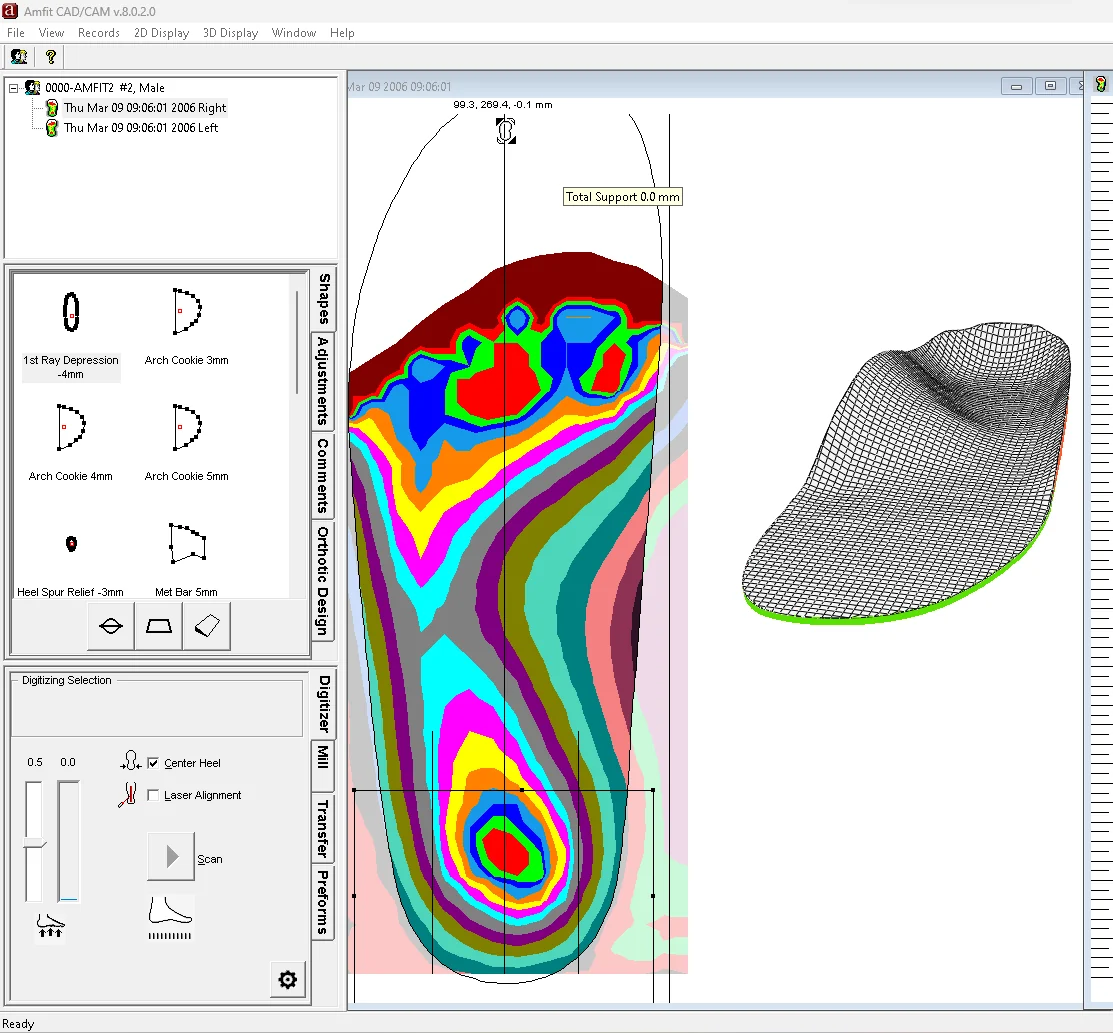
In Correct and Confirm, Amfit’s orthotic-design software, the scan can be viewed in three dimensions while the arch, heel cup, posting, thickness, accommodations, and reliefs are developed. The provider or Amfit Central Fabrication team can confirm that flexible areas are supported as intended and rigid or sensitive areas have the appropriate protection.
Accommodation protects the parts of the foot that should not be forced. Correction guides the areas that can benefit from controlled support. The most effective design may use both, based on the individual foot and the provider’s intended result.