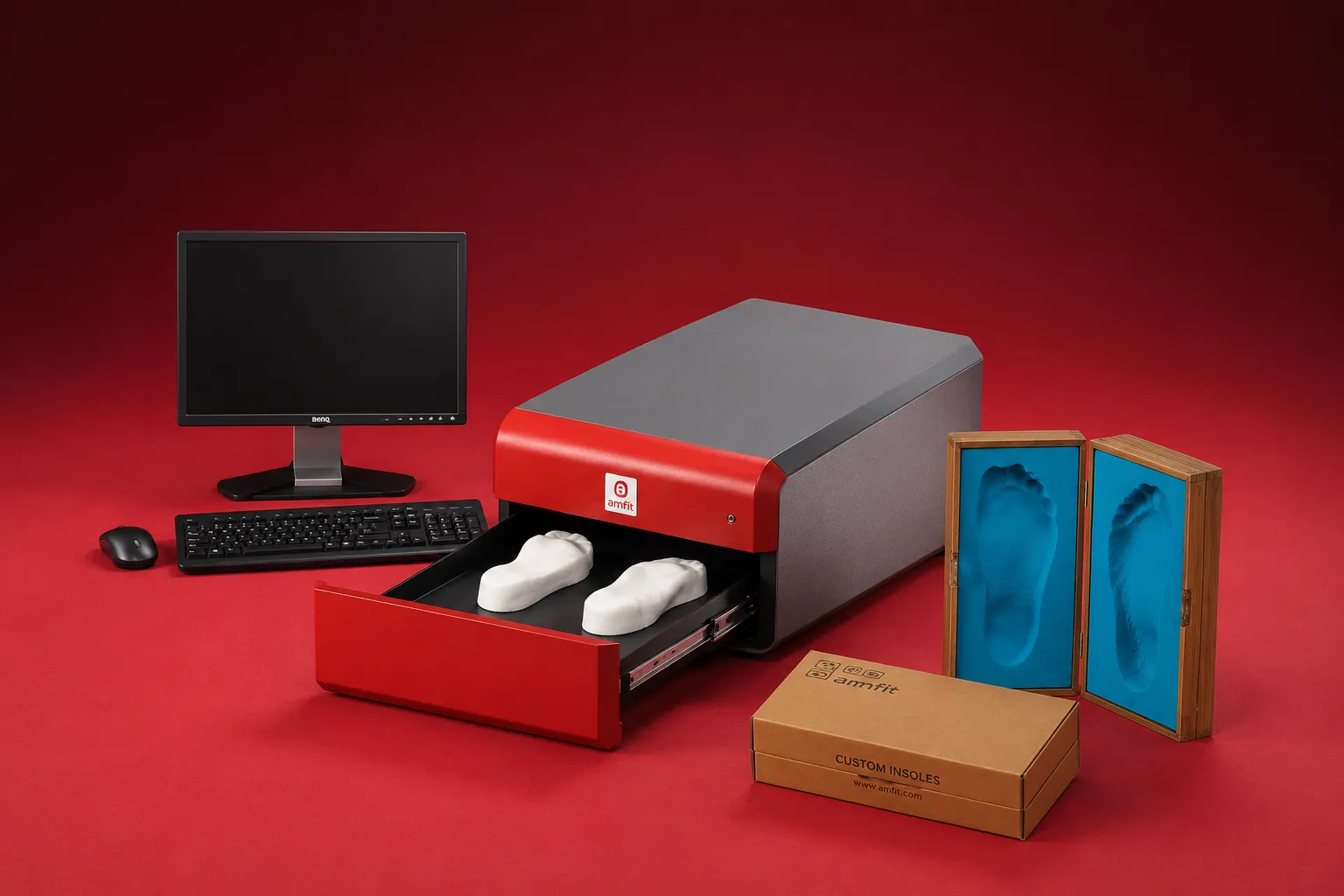
Every custom orthotic begins with a representation of the foot. Traditional casting creates that representation physically. Digital systems convert it into information that can be reviewed, corrected, stored, and moved into fabrication.
The important difference is not simply traditional versus digital. Each method captures something different, and that information becomes the foundation for the finished orthotic.
Traditional Casting
Traditional methods include plaster casting and foam impression boxes.
Plaster allows the provider to position the foot directly, but it requires materials, cleanup, and additional processing before fabrication begins.
Foam impression boxes offer a faster, cleaner option. The provider guides the foot into the foam to create a three-dimensional negative impression. The result can still be influenced by foam resistance, patient movement, uneven pressure, and provider technique.
Amfit’s Impress Scanner connects foam casting to a digital workflow by converting the impression into a file that can be reviewed, corrected, stored, and fabricated.
Digital Capture Is Not One Technology
Digital systems may all create a file, but the information inside that file can vary.
Laser and Structured-Light Scanners
Laser and structured-light scanners project light across the foot and use cameras or sensors to create a three-dimensional model of its exterior.
Some systems capture the foot without weight, while others require the patient to stand on a transparent platform. When the foot is placed against a surface, that contact can influence the shape recorded.
Because the model is created from reflected light rather than direct plantar contact, it records the exterior surface without measuring soft tissue deflection.
Flatbed Optical Scanners
Flatbed optical scanners use a camera beneath a transparent plate to photograph the bottom of the foot.
The image can show the outline, contact area, and visible features of the sole. Because it is a two-dimensional photograph taken against a flat surface, arch height, heel depth, and the changing height across the plantar surface must be estimated or measured another way.
Pressure Mats
Pressure mats use a grid of sensors to measure force as the patient stands or walks.
The result is a color-coded map showing where pressure is concentrated and how it changes during movement. This can help identify where pressure may need to be reduced or redistributed.
What it does not provide is the physical shape needed to create the orthotic. A pressure map may show increased heel or forefoot loading, but it does not define heel depth, arch height, tissue thickness, or the surface transitions needed beneath the foot.
A pressure map helps identify where change may be needed. Three-dimensional measurement provides the physical form needed to build that change into the orthotic.
Mobile Scan Apps
Mobile scan apps use photographs, video, or depth information from a phone or tablet to create a digital model.
Their greatest advantage is flexibility. Scans can be captured wherever patients are seen without requiring a dedicated scanning station.
Many app-based workflows focus primarily on producing the model. The file may move toward production without dedicated orthotic-design software or routine medical review. When the images or video do not capture the intended angle or alignment, there may be no separate step for correction.
Amfit Scan is designed differently.
The submitted scan moves into Correct and Confirm, where Certified Pedorthists review the capture and alignment alongside the diagnosis and provider instructions. Corrections can then be made within orthotic-design software before fabrication begins.
Contact Digitizing
The Amfit Contact Digitizer allows the provider to position the foot and capture it under full, partial, or minimal load.
Learn more in Weight-Bearing vs. Semi-Weight-Bearing vs. Non-Weight-Bearing Foot Capture.
Hundreds of pins rise to meet the bottom of the foot and measure the plantar surface point by point. Together, those measurements create a three-dimensional record that can move directly into orthotic design.
Because the pins make direct plantar contact, they also respond to differences between softer tissue and firmer areas. Calluses, bony prominences, and variations in tissue thickness can appear within the measured depth pattern rather than being limited to what is visible in a photograph or exterior scan.
This provides the shape needed around the heel, the height beneath the arch, and information that may help guide support, accommodation, or relief.
Choosing the Right Method
There is no single method that fits every patient or workflow.
Foam casting may remain appropriate when a physical impression is preferred. Pressure mapping can add useful information about loading. Mobile capture can extend access across multiple settings. Contact digitizing provides direct plantar measurement, soft tissue deflection, control over loading, and immediate digital review.
Amfit supports several paths into digital fabrication: direct contact digitizing, foam impression scanning, and professionally reviewed mobile capture.
The goal is not simply to create a digital file. It is to capture the right information, review it carefully, and carry it accurately into the finished orthotic.
Research Reference
Hearon K. Comparison of 3D Digital Contact Casting versus Manual Foam Casting of the Feet for the Design and Fabrication of Custom Foot Orthoses. 2008.