Every practice that prescribes custom orthotics eventually asks the same question: is it worth bringing fabrication in-house? The honest answer is "it depends on your volume", but almost no one shows you the actual math. This post does. We'll walk through a realistic profit-and-loss model, calculate the break-even point, and lay out the hidden costs and benefits that rarely make it into a sales pitch.
The outside-lab economics you already live with
If you're currently sending casts, foam boxes, or scans to a central fabrication lab, your per-pair economics look something like this:
- Lab cost per pair: $110 – $180 depending on material, correction complexity, and rush fees
- Shipping both ways: $15 – $35 per pair (or absorbed into "free shipping" that's baked into your price)
- Turnaround: 7 – 21 days from scan to fit appointment
- Average charge to patient / insurance: $350 – $600 per pair
Net margin after the lab bill: roughly $180 – $400 per pair. That's not bad. The problem isn't that outside labs are bad, it's that every single dollar you pay them comes out of a margin you could be keeping. And your patient waits two weeks.
The in-house math
In-house fabrication replaces the per-pair lab bill with a fixed equipment cost plus a much smaller consumables cost. The trade is upfront capital for ongoing savings.
Upfront equipment
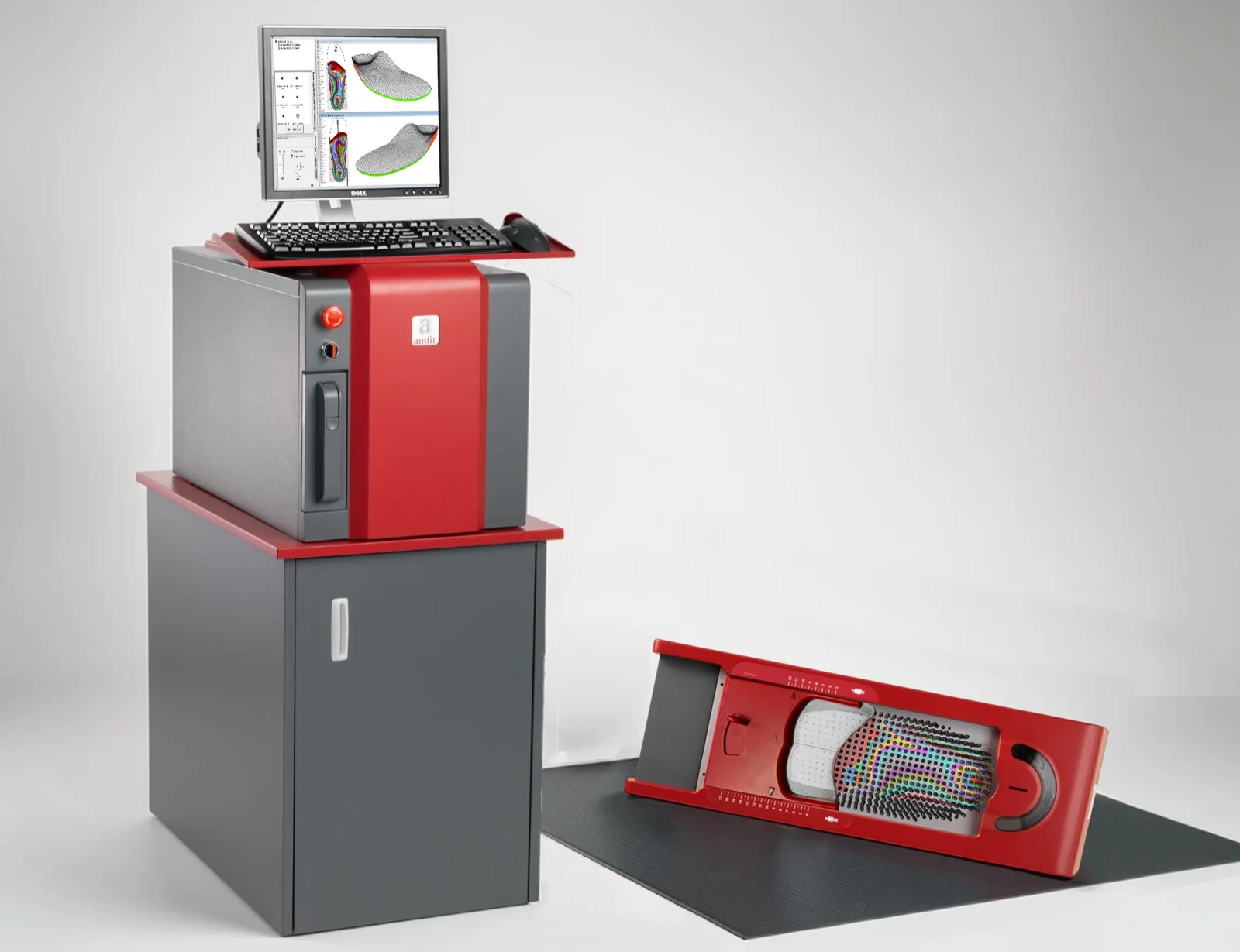
A full in-house system, scanner, CAD/CAM mill, clinical editing software, PC, monitor, stands, runs in the neighborhood of $32,000 to $55,000 depending on configuration (Amfit's base configuration sits at the lower end of that range). That's a real number, not a rounding error. But it's also a one-time number that you can finance over 3–5 years, depreciate against taxes, and amortize across thousands of pairs.
Per-pair variable cost
Once the equipment is in place, the only thing you pay for each orthotic is the EVA blank and a small amount of electricity plus tooling wear. Realistic numbers:
- EVA blank: $12 – $22 depending on density and material
- Top covers, glue, finishing: $4 – $8
- Tooling wear and electricity: ~$1
- Labor: 15 – 25 minutes of staff time (most practices already have the hands)
Call it $18–$30 per pair in true variable cost (Amfit's typical materials cost lands around $18). Compare that to $110–$180 with an outside lab. That's a $90–$160 margin swing on every single pair.
The question isn't "does in-house save money." It obviously does. The question is how many pairs per month you need to produce to make the capital worth it.
The break-even formula
Here's the simple version you can run on the back of a napkin:
Break-even formula: Break-even pairs = Equipment Cost ÷ (Outside Lab Cost per Pair − In-House Cost per Pair)
Worked example
Let's use round, conservative numbers:
- Equipment cost: $45,000
- Outside lab cost per pair: $140
- In-house cost per pair: $25
- Savings per pair: $115
Break-even = $45,000 ÷ $115 = 392 pairs. That's the total lifetime volume needed to recoup the equipment, not a monthly number. If your practice fabricates 20 pairs per month, you hit break-even in roughly 20 months. At 40 pairs per month, you're there in under a year. At 10 pairs per month, you're looking at 3+ years and in-house probably isn't right for you yet.
Three- and five-year cumulative savings
Break-even is just the starting line. The real money shows up in years 2, 3, 4, and 5, when the equipment is paid off and every pair after is essentially free margin.
- 15 pairs a month: $62,100 saved over 3 years; $103,500 over 5
- 25 pairs a month: $103,500 saved over 3 years; $172,500 over 5
- 40 pairs a month: $165,600 saved over 3 years; $276,000 over 5
- 60 pairs a month: $248,400 saved over 3 years; $414,000 over 5
Those figures are pre-equipment-cost. Subtract your $45K upfront and 25 pairs/month still nets roughly $127,500 over five years compared to continuing with an outside lab. That's a concrete number for a real practice.
The hidden benefits most ROI calculators miss
Raw savings per pair is the easy story. The harder story, the one practice owners notice six months in, is what changes in your clinic when patients don't have to wait.
Same-day fit changes everything
When a patient books a biomechanical exam, leaves with an orthotic the same day, and doesn't have to come back for a second fitting appointment, three things happen:
- Show-rate on follow-ups stops mattering. You can't no-show an appointment that doesn't exist.
- Patient satisfaction climbs. People are shocked and delighted when you hand them a finished custom device the same visit.
- Referral loop accelerates. The patient tells three people that day instead of three weeks later.
Schedule efficiency
Eliminating the fit appointment gives you back roughly 20 – 30 minutes of chair time per orthotic patient. If you're running a typical practice with 10 – 15 orthotic cases per week, that's 4 – 7 extra slots of billable chair time every month. In a busy practice, that alone pays for a big chunk of the equipment.
Control over materials and corrections
When you own the mill and the editing software, you can tweak a post, change a shell density, or add a metatarsal pad in two minutes. With an outside lab, that's another round trip.
The three honest downsides
It would be dishonest to pretend in-house is right for everyone. Here's what the sales pitch usually skips.
1. Learning curve
The software isn't hard, but it's new. Expect your first 20 – 30 orthotics to take longer than they will later. Budget a dedicated person, usually a tech or a mid-level clinician, to own the workflow. If nobody in your practice wants to be the "orthotic person," in-house will struggle.
2. Space requirement
A scanner, mill, computer, and prep area takes roughly 30 – 60 square feet. The mill is not silent. You need ventilation for EVA dust. If you're in a 900-square-foot lease, this matters. If you have a back room or a lab bench, it doesn't.
3. Upfront cost and financing
$45K is real money. Most practices finance it rather than pay cash. That's usually fine, the per-pair savings typically exceed the monthly equipment payment starting in month one, but if your practice is tight on cash flow or your credit situation is rough, the math changes.
Who in-house is right for
Based on hundreds of real practice conversations, here's the rough decision tree:
- Fewer than 10 pairs/month: Stick with central fabrication. Your volume doesn't justify the capital, and a good central lab is a great partner.
- 10 – 25 pairs/month: Consider starting with a scanner and outsourcing fabrication. You get better scan accuracy without the mill investment.
- 25+ pairs/month, or growing quickly: In-house usually makes sense. Break-even is under 18 months and the five-year math is hard to argue with.
- Retail or sports-focused practices where same-day is a selling point: In-house is almost always worth it regardless of volume, the marketing advantage alone can justify it.
Bottom line
In-house orthotic fabrication is one of the few capital investments in a practice that has a defensible, calculable ROI. It isn't magic and it isn't for everyone. But for any practice pushing 25+ pairs per month, and planning to keep doing so for the next five years, the numbers work out almost every time.
Run the formula for your own practice. If the break-even is under two years and you have the space and the team, you already have your answer.